New Faculty Profiles
I wish to instill excitement in students as they prepare for one of the most important careers in the world – the education of youth, (...).
Champion for the Autistic Community:
A Conversation with Assistant Professor Steven Shore
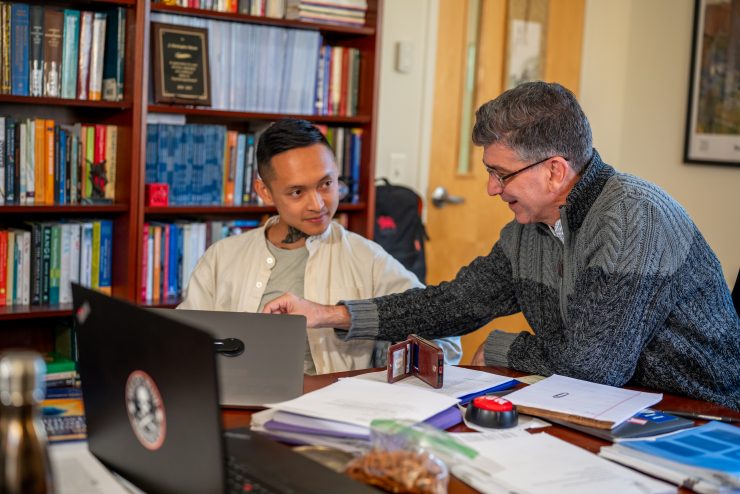
Assistant Professor of Education Steven Shore specializes in the autism spectrum.
“As a person diagnosed with autism, nonverbal (disorders), and (who was) recommended for institutionalization at the age of two-and-a-half years old, my goal is to combine my personal, educational, and practical experiences to help people on the autism spectrum reach their greatest potential,” he said.
One area of interest that Dr. Shore focused on in his dissertation is comparing the numerous interventions for treating autism with the goal of moving research towards matching best practices to the diverse needs of children on the autism spectrum, as opposed to trying to make people with autism fit into the mold of any particular approach.
Another focus of Dr. Shore’s is maximizing educator effectiveness in preparing people with autism for the successful transition to adulthood, in areas such as self-advocacy, residential life, continuing and higher education, as well as fostering interpersonal relationships and maintaining gainful employment.
In his spare time, Dr. Shore gives music lessons to children on the autism spectrum. “In addition to the therapeutic benefits of music and just being plain old fun, facility as a musician gives the person an important key towards developing relationships with others and the community as a solo performer or a member of a musical ensemble,” he said.
VIDEO INTRODUCTION:
A current Flash Player is required to view this video. For the free download, click here.
For the best viewing quality, after clicking "Play Movie" we recommend to pause the movie and wait until the white status bar underneath the movie has turned grey. At that point the entire move will have pre-loaded to your computer and the play button can be clicked again. Broadband Internet connection is recommended.
QUESTIONNAIRE:
How did you choose Adelphi?
Adelphi’s student-centered approach, combined with its emphasis on teaching, research, and community service, are some of the factors that attracted me to Adelphi University. I’ve been to the campus several times to deliver presentations at the spring AHA Autism Conference, and have found people very supportive and helpful. Additionally, the Ruth S. Ammon School of Education’s desire to build programs in supporting students with autism was very attractive to me.
What has been your experience so far?
Adelphi is a great place to collaborate with my colleagues in making the world a better place for people on the autism spectrum. I sense true support from other faculty, staff, and administration for my success here at this University.
What do you wish to contribute to your field, both in terms of teaching and research?
If I can make life better for even one person on the autism spectrum my work will be worthwhile. Even though I have been here just a short time, I am very excited about the great things that will happen as a direct result of truly supportive collaboration with others.
Additionally, I am honored to be surrounded by people who are so willing to share experiences and suggestion with me as I work daily to improve my role here as educator and facilitator for the development of my students.
What do you wish to impart to your students?
I wish to instill excitement in students as they prepare for one of the most important careers in the world – the education of youth, along with the realization that education is a collaborative experience, starting with the interaction between the teacher and the student.
Another area of importance is the idea that accommodations and modifications to curricula are actually extensions of good teaching practice, with the end goal of making education more accessible to everyone, as we move towards a more universal design in curriculum development. 
◆ 79297 visits. ◆